If you are asking “how many solar panels do i need,” start with your electricity use, not your home’s square footage. Two similarly sized homes can need very different systems because of air conditioning, electric heating, pool pumps, driving habits, and roof conditions.
A useful estimate combines annual electricity consumption, local solar production, and panel wattage. The steps below help you calculate a starting range, understand why an installer’s proposal may differ, and decide whether a larger system would actually serve your household.
Start With Your Electricity Use
Collect 12 consecutive months of electric bills and add the electricity consumed, measured in kilowatt-hours (kWh). Use consumption rather than the bill’s dollar amount: utility rates, fixed charges, and seasonal pricing can change without a corresponding change in usage.
If you already have solar, your utility statement may show only electricity imported from the grid, not total household consumption. Combine utility information with your existing system’s production and consumption records where available.
- Add annual usage: Total the kWh listed for all 12 months.
- Check unusual periods: Flag vacancies, construction, or unusually heavy equipment use.
- Account for planned changes: Include realistic estimates for an electric vehicle, heat pump, or other major new load.
- Subtract expected savings: Consider efficiency improvements you genuinely plan to complete.
A smaller, efficient home with electric heating can consume more electricity than a larger home heated with gas. Square footage alone therefore makes a weak sizing shortcut.
Convert Usage Into System Capacity
Solar array capacity is usually expressed in kilowatts of direct-current power, written as kW DC. Electricity production is measured in kWh. Capacity describes the array’s rated power; production describes the energy it generates over time.
The most useful sizing input is estimated annual production per installed kW DC for your specific location and roof. This is sometimes called annual specific yield. It should account for orientation, tilt, shading, weather patterns, and modeled system losses.
Estimated system size in kW DC = desired annual solar production in kWh ÷ estimated annual production in kWh per kW DC.
Next, convert the proposed panel rating from watts to kilowatts by dividing by 1,000. Divide the system size by that panel rating, then round up to a whole panel for a preliminary count. Final equipment and layout decisions may change that number.
A solar system size calculator can provide a starting estimate, but inspect its assumptions. A result based only on ZIP code and monthly spending is less tailored than one using actual kWh consumption and individual roof planes.
A Worked Panel-Count Example
Consider this hypothetical household—not a national average or a production guarantee:
- Annual household electricity use: 10,800 kWh.
- Desired annual solar production: 90% of use, or 9,720 kWh.
- Modeled annual yield: 1,350 kWh per kW DC.
- Selected panel rating: 400 watts, or 0.400 kW.
The estimated array capacity is 9,720 ÷ 1,350 = 7.2 kW DC. The preliminary panel count is 7.2 ÷ 0.400 = 18 panels.
Under a different hypothetical roof assessment, the yield might be only 1,100 kWh per kW DC. The same production target would require about 8.84 kW DC, or 23 of those 400-watt panels after rounding up.
Alternatively, 450-watt panels could provide 7.2 kW DC with 16 panels. That does not automatically mean less roof area: higher-wattage panels may have different dimensions. Compare the actual layout, not just the panel count.
These calculations estimate annual energy balance. They do not mean the home operates independently of the grid or receives a bill that is 90% lower.
Check What Your Roof Can Support
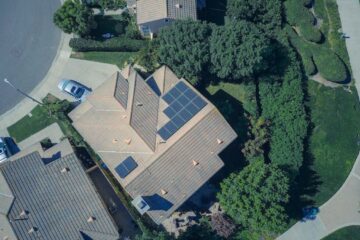
Usable roof area is smaller than total roof area. Chimneys, vents, skylights, access pathways, required setbacks, and awkward edges can prevent panels from fitting where a simple area calculation suggests they should.
For illustration only, if each selected panel occupies 21 square feet, 18 panels occupy 378 square feet before access spaces and layout constraints. Have the installer show panel dimensions and a scaled placement plan.
Orientation and Shade
In much of the United States, an unshaded south-facing array can provide strong annual production. East- and west-facing roofs can also work, with different generation timing. Afternoon production may be particularly useful when household demand or electricity prices rise later in the day.
Ask for production estimates by roof plane and a shade assessment that considers seasonal sun angles. Microinverters or optimizers can help manage differences between panels, but they cannot recover sunlight blocked by a tree or building.
Roof and Electrical Condition
Resolve roof repairs before installation when practical. Ask whether structural review, electrical panel upgrades, or utility interconnection limits affect the design. Include potential panel removal and reinstallation costs when comparing solar installation now with roof replacement first.
Size for Value, Not Just Offset
Matching annual solar generation to annual consumption is an energy target, not necessarily the best financial target. Your home may export surplus electricity at midday and buy electricity after sunset at a different price.
Net metering and net billing are not interchangeable. Depending on the tariff, exports may receive credits calculated differently from imported electricity. Credits are not necessarily retail-rate credits or cash payments. California net billing, for example, uses variable export compensation; review the applicable utility schedule.
Here is simplified hypothetical math: if a home directly uses 1,000 kWh of solar electricity that would otherwise cost $0.25 per kWh, the avoided energy charge is $250. If another 1,000 kWh is exported at an assumed $0.07 per kWh, those exports earn $70 in credits. Actual tariffs, timing, and non-offsettable charges change the result.
This is why adding panels solely to maximize exports may be less valuable than shifting flexible loads into sunny hours. Request an analysis using interval usage data when available, especially under time-of-use pricing.
Plan for EVs and Electric Heating
Future loads deserve explicit calculations rather than a blanket recommendation to oversize. For a hypothetical EV driven 10,000 miles annually at 0.30 kWh per mile, vehicle energy use would be 3,000 kWh before charging losses. Home charging demand also depends on how often you charge elsewhere.
Heating changes require more care. Replacing a gas furnace with a heat pump adds electric demand, while replacing electric resistance heating with a heat pump may reduce it. Climate, insulation, equipment performance, and backup heating all matter.
Ask the installer to show both present-use and future-use designs. Verify whether the utility permits the proposed capacity and whether later expansion would require different inverter equipment or a revised interconnection agreement.
Separate Solar From Backup Needs
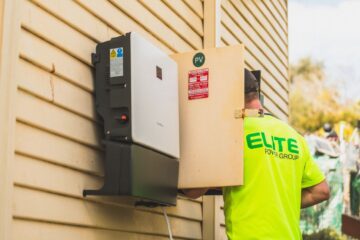
Solar sizing and battery sizing answer different questions. Solar panels supply energy; a battery stores energy and delivers power within its operating limits. Ordinary grid-tied solar generally shuts down during a grid outage unless the system includes equipment designed for backup operation and safe islanding.
Battery capacity in kWh helps determine how long selected loads can run. Battery output in kW determines how much equipment can run simultaneously, subject to surge capabilities and other limits.
List critical loads such as refrigeration, lighting, communications, and necessary medical equipment. A hypothetical steady 0.5 kW load needs 5 kWh over 10 hours, before allowing for losses and reserve settings.
When comparing Tesla Powerwall, Enphase, and FranklinWH, evaluate system architecture, compatibility with existing solar, supported backup loads, and expansion options. Check current specifications, warranty terms, and a complete installed quote rather than choosing by brand or nominal capacity alone.
Review Quotes and Incentives Carefully
Compare proposals using array capacity in kW DC, inverter capacity in kW AC, annual modeled production, and clearly stated assumptions. A larger panel count does not necessarily mean a larger or better-producing system.
As of October 9, 2026, the federal Residential Clean Energy Credit under section 25D is not available for property placed in service after December 31, 2025. Do not build a new 2026 residential installation budget around the former 30% credit. Verify any state, local, or utility incentive separately, including eligibility and deadlines.
“No-cost solar” generally describes financing, a lease, or a power purchase agreement—not free equipment and electricity. Legitimate assistance programs may exist, but verify their sponsor and written terms. With a lease or PPA, inspect payment escalation and transfer requirements; with owned systems, review any outstanding financing before a home sale.
Your Pre-Contract Checklist
- Confirm annual consumption and document future-load assumptions.
- Request a roof-specific production model and shade assessment.
- Check panel dimensions, equipment ratings, and roof condition.
- Read import rates, export credits, and unavoidable utility charges.
- Compare itemized cash and financed prices, including added work.
- Verify incentives without assuming federal section 25D eligibility.
- Review warranties, service responsibilities, and ownership or transfer terms.
Frequently Asked Questions
Will solar eliminate my bill?
Not necessarily. Fixed charges, nighttime imports, seasonal differences, and export compensation can leave a balance even when annual solar production equals annual consumption. Ask for an estimated bill under your actual tariff.
Can I install fewer panels now?
Yes, but expansion is not always straightforward. Reserve suitable roof space and discuss inverter capacity, equipment compatibility, permitting, and utility approval before assuming more panels can be added cheaply later.
Do panels produce on cloudy days?
They can, but output falls with reduced sunlight. Use modeled annual and monthly production rather than assuming nameplate output throughout daylight hours. Seasonal variation matters particularly for homes with substantial winter heating demand.
Should I buy the highest wattage?
Not automatically. Compare installed cost, panel dimensions, efficiency, warranty terms, and the production achievable on your roof. A lower-wattage module may fit an awkward roof more effectively than a larger module.
Choose a Defensible Panel Count
Start with annual kWh, choose a realistic production target, and divide by roof-specific yield and panel wattage. Then test that estimate against roof constraints, future loads, utility rules, and your budget. The right number is the one supported by a transparent design—not a sales shortcut.
This article provides general information, not individualized engineering, tax, legal, or financial advice. Confirm site requirements, tariffs, and program eligibility with qualified professionals and the relevant authorities.
Official References
https://www.energy.gov/energysaver/solar-energy
https://www.irs.gov/credits-deductions/residential-clean-energy-credit
https://consumer.ftc.gov/consumer-alerts/2024/08/how-avoid-getting-burned-solar-or-clean-energy-scams
https://www.cpuc.ca.gov/industries-and-topics/electrical-energy/demand-side-management/customer-generation