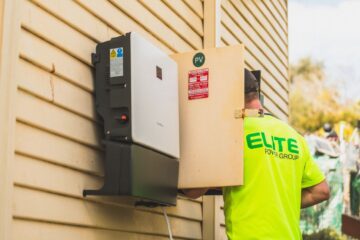
A solar battery stores electricity for later use, whether that means covering evening consumption or keeping selected circuits running during an outage. For US homeowners, the right system depends less on brand recognition than on utility rates, backup priorities, existing equipment, and the installed contract.
Tesla Powerwall is a familiar option, but Enphase and FranklinWH deserve consideration. This guide explains how to compare them, evaluate quotes, and avoid misleading savings claims, using the federal tax rules applicable as of October 9, 2026.
Decide What Storage Must Do
Start with a specific objective. A battery bought primarily for outage protection may be operated differently from one bought to reduce expensive evening electricity purchases. Keeping energy in reserve improves outage readiness but leaves less available for daily bill management.
- Essential backup: Prioritize refrigeration, lighting, internet equipment, selected outlets, and necessary medical devices.
- Extended resilience: Plan for overnight needs, cloudy weather, and the ability to recharge from solar during an outage.
- Bill management: Compare charging costs and forgone export credits with the utility charges that discharging can actually avoid.
Grid-connected solar panels alone generally stop supplying power during an outage for safety. Backup requires compatible equipment that isolates the home from the utility grid, plus controls that coordinate the battery and any solar production. A battery installation does not automatically include whole-home backup.
Separate Power From Stored Energy
Battery capacity, measured in kilowatt-hours (kWh), describes stored energy. Output, measured in kilowatts (kW), describes how much power the system can deliver at once. Both matter: enough energy for a night does not guarantee enough output to start an air conditioner or well pump.
Ask for usable capacity, continuous backup output, and any short-duration surge capability. Confirm whether specifications change with the number of batteries, temperature, operating mode, or available solar. Equipment ratings should correspond to the exact proposed model, not a different product generation.
A Hypothetical Backup Calculation
Suppose your selected loads average 0.6 kW across ten hours. They would consume 0.6 kW × 10 hours = 6 kWh. Adding an assumed 15% planning allowance for conversion losses and uncertainty produces a target of 6.9 kWh of available stored energy.
This is illustrative, not a product recommendation. The allowance is an assumption, not a measured efficiency rating. Actual runtime depends on charge level, temperature, battery aging, equipment cycling, and user behavior.
Now suppose those circuits occasionally need 4 kW simultaneously. The system must support that demand as well as the energy target. Have the installer assess motor-starting loads separately and document any appliances that cannot run together.
Compare Three Storage Approaches
Tesla, Enphase, and FranklinWH can all be considered for residential storage, but compatibility and system design determine whether a particular proposal works. Compare current manufacturer documentation and written installed quotes rather than assuming every model offers the same capacity, controls, or expansion options.
Tesla Powerwall
Powerwall is worth evaluating when you want coordinated battery, solar, and app-based energy management. Some Powerwall configurations incorporate solar inverter functionality; the exact model and installation architecture matter, especially when adding storage to existing panels.
Ask which gateways, switches, metering, and load controls are included. For expansion, confirm which battery units can work together and whether adding storage later requires additional electrical work. Do not assume a quote covers every circuit simply because it uses the Powerwall name.
Enphase
Enphase is a useful comparison for homeowners with an Enphase microinverter-based solar system. Its battery offerings use an AC-coupled approach, which can be relevant when retrofitting storage without replacing an existing solar inverter. Compatibility still requires confirmation.
Ask how many battery units are needed to meet both your energy and output targets. Have the installer explain the required system controller, communications equipment, and commissioning process, particularly if your existing Enphase equipment is older.
FranklinWH
FranklinWH emphasizes home energy management through a battery and control-system approach. It is worth investigating when coordinating existing solar, selected household loads, and potentially a generator is central to the project.
Generator integration is not automatic compatibility with every generator. Request a written diagram identifying supported equipment, transfer arrangements, charging behavior, and load controls. As with the alternatives, local installer experience and service responsiveness deserve weight alongside hardware specifications.
Read Beyond the Equipment Price
A search for tesla powerwall cost is only a starting point. A hardware price is not an installed project price, and a quote for one home cannot establish a reliable national total. Electrical condition, backup scope, permits, and local labor affect the proposal.
Require itemized pricing for batteries, inverters where applicable, isolation equipment, installation labor, permitting, utility interconnection, and commissioning. Identify allowances for panel upgrades, trenching, relocating equipment, and repairing finished surfaces. Ask whether taxes and inspection corrections are included.
Compare cash pricing separately from financing. Request the annual percentage rate, loan term, dealer or origination fees, total payments, and prepayment rules. A lower monthly payment can conceal a longer obligation or a higher financed principal.
Check 2026 Incentives Carefully
The federal Residential Clean Energy Credit under Section 25D is not available for property placed in service after December 31, 2025. Do not budget a 30% federal residential credit for a new installation placed in service in 2026. The IRS confirms this termination on its Residential Clean Energy Credit page.
If a proposal includes a federal tax benefit, ask the seller to identify the specific provision, eligible taxpayer, and timing requirements. A homeowner purchase and a third-party-owned arrangement are not interchangeable tax situations. Avoid treating a salesperson’s projection as tax advice.
State, local, and utility programs may still exist, but availability and eligibility require verification. Check application deadlines, reservation requirements, funding status, approved equipment, and obligations to let the utility dispatch your battery. Confirm whether participation affects backup reserves or export compensation.
Calculate Savings Under Your Tariff
Net metering and net billing are different compensation structures. An exported kilowatt-hour does not necessarily receive the retail electricity price, and a bill credit is not necessarily redeemable for cash. Read your utility’s current tariff, including time periods, credit expiration, and charges that storage cannot avoid.
California net billing includes variable export values, making the timing of exports important. Do not apply California rules to another state—or even assume every California customer has the same tariff. Your utility, interconnection history, and rate plan matter.
A Hypothetical Daily Savings Test
Assume 10 kWh of surplus solar would otherwise earn an export credit of $0.08 per kWh. Sending that energy to storage instead gives up $0.80 in credits. Assume an illustrative 90% round-trip efficiency, leaving 9 kWh to serve evening loads.
If each discharged kilowatt-hour avoids $0.30 of eligible utility charges, the avoided purchase is 9 × $0.30 = $2.70. Subtract the $0.80 forgone export credit, and the modeled benefit is $1.90 for that day, before other costs or operating constraints.
These are hypothetical rates and performance assumptions, not current tariff or product claims. Annual results require seasonal solar production, household usage, reserve settings, degradation, and actual rate schedules. Backup protection also has personal value, but it should not be presented as guaranteed bill savings.
Plan Installation and Ownership
Have the installer inspect the electrical panel, proposed battery location, wiring routes, and internet connectivity requirements before finalizing scope. Local permitting and fire-safety requirements may restrict placement or require protective measures. Flood exposure, vehicle impact, and temperature conditions also deserve attention.
Request a circuit-level backup plan and a demonstration at commissioning. Confirm what happens when the battery reaches its minimum charge, how solar restarts or recharges during an outage, and whether settings remain functional if internet service fails.
Read warranty exclusions and separate equipment coverage from installer workmanship coverage. Compare warranty duration, retained-capacity commitments, throughput or cycling limits, and who pays diagnostic labor, shipping, and replacement installation.
Ownership matters when selling the home. Purchased equipment, financed equipment, leases, and power purchase agreements can have different payoff, transfer, or buyer-approval requirements. “No-cost solar” usually describes financing, a lease, or a PPA—not free equipment. Legitimate assistance programs may exist, but verify the sponsor and written terms independently.
Your Pre-Contract Checklist
- Collect twelve months of bills and, if available, interval usage data.
- List essential circuits, expected outage duration, and large starting loads.
- Obtain comparable quotes with identical backup scope and clear exclusions.
- Verify exact equipment models, compatibility, and expansion requirements.
- Confirm tariffs and incentives directly with the responsible agencies or utility.
- Review payment milestones, cancellation terms, warranty service, and ownership transfer.
Frequently Asked Questions
Can a battery run my whole house?
Possibly, but “whole-home” connection does not mean unlimited power or runtime. Electric heating, vehicle charging, cooking, and cooling can exceed output or quickly consume stored energy. Load management or additional storage may be necessary.
Can I add storage to older solar?
Often, yes. The installer must check inverter compatibility, electrical capacity, existing warranties, and interconnection requirements. Ask whether the change affects your current export arrangement before authorizing work.
Can a battery charge from the grid?
Many systems support grid charging, but permission and economic value depend on equipment settings, utility rules, and program restrictions. Confirm charging schedules and whether grid-charged energy can be exported.
Does storage eliminate my utility bill?
Not necessarily. Fixed charges, seasonal energy shortfalls, and non-offsettable charges can remain. Require an annual bill model using your tariff rather than accepting a promise of a zero bill.
Choose the System, Not Just the Brand
The best-fit solar battery matches your loads, backup expectations, and utility economics. Compare Powerwall, Enphase, and FranklinWH through documented designs and complete contracts. A clear scope and realistic operating model are more useful than a low headline price.
This article provides general information, not individualized electrical, financial, legal, or tax advice. Verify requirements and program terms before committing.
Official References
https://www.energy.gov/energysaver/solar-energy
https://www.irs.gov/credits-deductions/residential-clean-energy-credit
https://consumer.ftc.gov/consumer-alerts/2024/08/how-avoid-getting-burned-solar-or-clean-energy-scams
https://www.cpuc.ca.gov/industries-and-topics/electrical-energy/demand-side-management/customer-generation