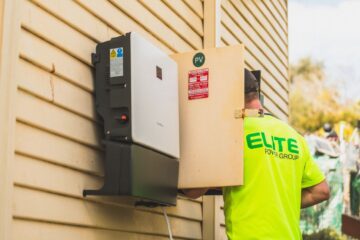
Net metering lets eligible households earn utility bill credits when their solar panels send surplus electricity to the grid. Those credits can offset electricity purchased at other times, but their value depends on your utility’s rules—not simply how many panels you install.
If you want to sell electricity back to grid operators through a residential solar program, start with the tariff, not the sales pitch. As of October 9, 2026, there is no single nationwide credit formula, and exporting power does not necessarily produce a cash payment.
How the Power and Credits Flow
Solar panels generate electricity during daylight. Your home uses available solar production first; any excess can flow through an approved meter to the utility network. When household demand exceeds production, you import electricity unless a battery supplies the difference.
Your meter records the relevant energy flows, and your utility applies its billing rules. Electricity is measured in kilowatt-hours, or kWh. A kilowatt, or kW, measures power at a particular moment: a 2-kW appliance running for one hour uses 2 kWh.
Under some net metering tariffs, eligible exported kWh offset imported kWh within a billing period. Others use time-of-use periods or additional accounting rules. Even a home exporting as much electricity as it imports over a year may still owe fixed charges, minimum bills, or charges that credits cannot offset.
Net Metering Versus Net Billing
These terms describe different compensation structures, although sales presentations sometimes blur them. Request the actual tariff name and written calculation method.
- Net metering: Imports and exports are netted under the program’s rules. Credits may offset eligible retail energy charges, but not necessarily every component of the bill.
- Net billing: Imported electricity and exported electricity are valued separately. Exports may receive less than the retail import price, with compensation varying by time or other tariff conditions.
- Cash settlement: Payment for leftover credits, if offered, follows separate rules. A bill credit is not automatically redeemable for cash.
California illustrates why labels matter. Its major investor-owned utilities use net billing arrangements for many newer eligible customer-generators, with export values that vary over time. Older systems may retain different treatment under legacy rules. Municipal utilities and other providers can have different programs; “California solar rates” is not a sufficient description.
The practical distinction is between avoided purchases and export earnings. Using one solar kWh at home avoids the applicable marginal import charge. Exporting it earns whatever the export tariff provides. Those values may differ substantially.
Read These Rules Before Signing
Ask your utility to identify the tariff available for your address and proposed system. Then compare its written terms against the installer’s savings model.
- Confirm eligibility. Check utility territory, customer class, system-size limits, program availability, and whether planned capacity must relate to historical consumption.
- Identify the credit formula. Ask which charges exports offset and whether rates change hourly, seasonally, or by time-of-use period.
- Find the settlement date. Determine whether unused credits roll forward, expire, or receive a different value at an annual true-up.
- List unavoidable charges. Request fixed, minimum, nonbypassable, and any applicable demand charges. Ask how credits interact with each.
- Check future changes. Understand any grandfathering period and whether expansion, battery additions, ownership changes, or account transfers affect it.
- Clarify interconnection. Identify application fees, required equipment, possible service upgrades, inspections, and who obtains permission to operate.
A signed installation contract is not utility authorization to export. Have the installer explain responsibility for delays, rejected applications, and any required export limits. Do not assume the system can operate immediately after panels reach the roof.
A Hypothetical Monthly Bill
The following numbers are illustrative, not current utility rates or a production forecast. Suppose a household uses 900 kWh during one month. Its solar array produces 700 kWh: 300 kWh is consumed directly, and 400 kWh is exported. The household therefore imports 600 kWh.
Assume imported energy costs $0.25 per kWh, exported energy earns $0.08 per kWh under net billing, and there is a $20 monthly fixed charge. Ignore taxes, tiering, and other adjustments for this simplified comparison.
- Without solar: 900 kWh × $0.25 + $20 = $245.
- With solar: 600 kWh × $0.25 − 400 kWh × $0.08 + $20 = $138.
- Monthly bill reduction: $245 − $138 = $107, before financing, maintenance, or other ownership costs.
Now suppose an eligible net metering tariff instead offsets imported and exported energy at the same $0.25 rate within that month. Net purchases would be 200 kWh, producing a simplified bill of $70 including the fixed charge. The reduction would be $175.
Neither result is an annual savings estimate. Weather, seasonal demand, rate periods, and settlement rules change the outcome. The example shows why identical solar production can have different financial value under different tariffs.
Size Solar Around Useful Energy
Start with at least 12 months of electricity bills and, where available, interval usage data. Annual kWh establishes scale; hourly patterns reveal how much production you may consume directly. Include credible future changes such as an electric vehicle or heat pump, rather than speculative demand.
Ask bidders to show annual production, expected self-consumption, exported kWh, and the assumptions behind each. Shade, roof orientation, equipment losses, and production degradation should be reflected in the forecast. A proposal showing only annual generation and one savings figure hides important trade-offs.
Under lower export compensation, the largest permitted array is not automatically the best financial choice. Request a smaller-system alternative and compare the incremental cost with the value of its additional energy. Oversizing to accumulate credits can disappoint if those credits expire or settle at a lower rate.
Load shifting may help without adding panels: schedule flexible EV charging, laundry, or water heating during productive hours when safe and practical. Check your time-of-use schedule first, and do not confuse reduced costs with reduced energy consumption.
When Batteries Help—and When Not
A battery can store midday surplus for later use, potentially replacing expensive imports instead of accepting a low export credit. Its value depends on usable capacity, conversion losses, operating settings, rate differences, degradation, and installed cost. It does not create additional solar energy.
Keep power and energy separate. A battery’s kW rating affects which appliances it can run simultaneously; usable kWh affects duration. For example, 10 kWh of usable stored energy supplying a constant 1 kW load suggests roughly 10 hours before accounting for operating reserves and losses.
Backup is a separate design question. Grid-tied solar alone often shuts down during an outage for safety. Operating through an outage requires compatible controls and proper islanding equipment that isolates the home from utility lines. Identify critical loads, starting surges, and whether solar can recharge the battery during an outage.
When comparing Tesla Powerwall, Enphase, and FranklinWH, focus on the proposed configuration rather than brand reputation. Compare inverter integration, compatibility with existing solar, modular expansion, load controls, and local service support. Check current model specifications, warranty conditions, and itemized installed quotes; product capabilities can change.
Ownership, Incentives, and Payback
The federal Residential Clean Energy Credit under Section 25D is not available for property placed in service after December 31, 2025. Do not include a 30% federal residential credit in the economics of a new 2026 installation. Verify tax treatment directly with the IRS and a qualified tax professional.
State, local, and utility incentives may still exist, but funding, deadlines, equipment requirements, and eligibility vary. Count an incentive only after verifying the applicable terms, including whether combining programs is allowed.
For a cash purchase, compare the full installed price with modeled net savings across a reasonable ownership period. For financing, include interest, dealer fees, and payment changes. Test less favorable assumptions, including lower export values and higher maintenance costs, instead of relying on a single payback date.
With a lease or power purchase agreement, the provider generally owns the equipment. Check escalators, maintenance obligations, buyout options, and home-sale transfer requirements. Owned systems also deserve a transfer review, particularly when a loan or utility agreement remains in place.
“No-cost solar” usually describes financing, a lease, or a PPA—not free equipment. Legitimate assistance programs may exist, but verify the administrator and written eligibility terms independently.
Your Precontract Checklist
- Obtain the utility tariff and an explanation of credit rollover and true-up.
- Request separate estimates for direct solar use, exports, and remaining purchases.
- Compare itemized quotes using consistent production and rate assumptions.
- Confirm roof condition, electrical upgrades, permits, and interconnection responsibilities.
- Document equipment warranties, workmanship coverage, and service contacts.
- Read cancellation, financing, property-sale, and transfer terms before signing.
Frequently Asked Questions
Will the utility send me a check?
Not necessarily. Many arrangements provide bill credits. Any cash payout may apply only at settlement and may use a different rate. Ask specifically how an unused annual balance is handled.
Can solar eliminate my bill?
It can reduce eligible electricity charges, but fixed fees and other unavoidable charges may remain. Seasonal imports, low export compensation, or credit expiration can also leave a balance.
Do I need a battery to participate?
Generally, a battery is not inherently required for net metering, although program and equipment rules vary. Evaluate storage separately for bill savings and backup needs rather than accepting it as an automatic requirement.
What happens when I move?
Check both the utility tariff and your ownership contract. Credit balances, legacy eligibility, financing, and lease or PPA obligations may follow different transfer rules. Resolve these questions before listing the home.
Make the Tariff Your Starting Point
Net metering can make rooftop solar more useful financially, but the strongest proposal explains exactly how your utility values electricity. Match system size to realistic demand, distinguish credits from cash, and evaluate ownership costs alongside bill reductions.
This article is general information, not individualized tax, legal, electrical, or financial advice. Confirm current utility requirements and program eligibility before committing.
Official References
https://www.energy.gov/energysaver/solar-energy
https://www.irs.gov/credits-deductions/residential-clean-energy-credit
https://consumer.ftc.gov/consumer-alerts/2024/08/how-avoid-getting-burned-solar-or-clean-energy-scams
https://www.cpuc.ca.gov/industries-and-topics/electrical-energy/demand-side-management/customer-generation